
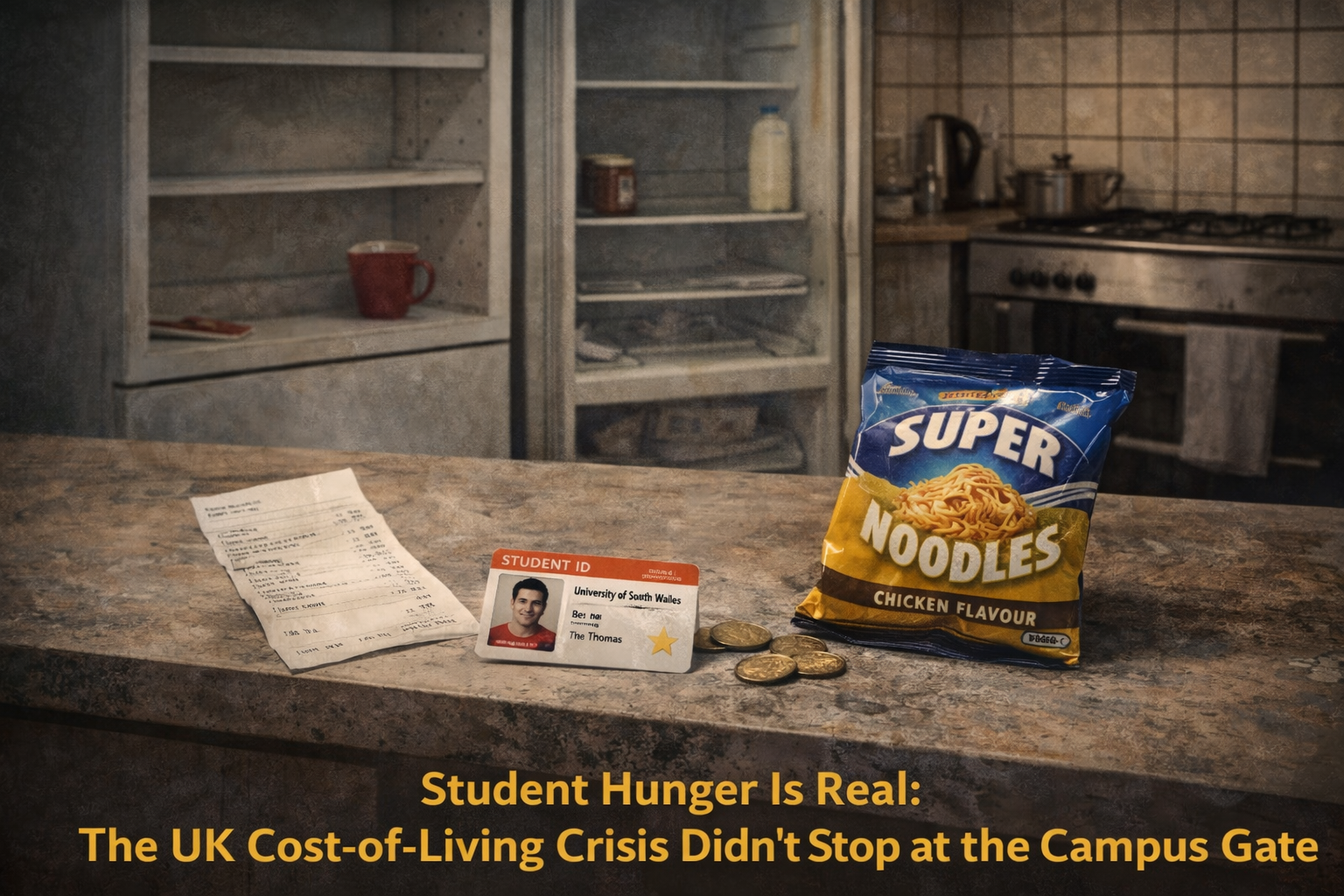
Student Hunger Is Real: The UK Cost-of-Living Crisis Didn’t Stop at the Campus Gate
// NO DESCRIPTION DATA
Student hunger is the quiet crisis nobody wants to admit
There’s a fantasy that students are “broke but fine”.
In reality, for many it’s:
broke and skipping meals.
The National Union of Students (NUS) found 14% of students used food banks in 2023/24, up from 7% in 2021/22.
That’s not a quirky uni experience.
That’s poverty showing up early.
Maintenance loans are not matching living costs
One reason this is happening: the gap between income and reality.
Save the Student reported that the average maintenance loan received by students in England was £640 per month, while average living costs were £1,142 per month, leaving a monthly shortfall of £502.
You can’t “budget harder” out of that.
You can only cut essentials.
Guess which essential goes first.
Food is the easiest thing to cut, so it gets cut
Students rarely default to “no rent”.
They default to:
- cheaper food
- smaller meals
- fewer meals
- skipping fresh ingredients
- living on whatever is fastest and filling
This creates a loop:
less food → less focus → worse study → more stress → worse health.
Hunger hits students differently than families, but the damage is real
Student hunger often looks like:
- not eating until late afternoon
- relying on snacks instead of meals
- “stretching” one cheap meal across two days
- social isolation because eating out is impossible
And because it’s hidden, it’s easier for institutions to ignore.
Why student hunger becomes long-term debt
When money doesn’t stretch, students turn to:
- overdrafts
- credit
- late payments
- borrowing from friends
- hardship support (if accessible)
And once you’re in that loop, the mental bandwidth vanishes.
Food insecurity becomes a background condition, not a one-off event.
What student-focused food support should look like
Good support for students needs to be:
- low-friction
- stigma-free
- consistent
- designed around study schedules
- linked to advice (not just food)
This isn’t about charity optics.
It’s about keeping young adults stable enough to finish what they started.
What Feed & Flow can do here
Feed & Flow can support student hunger by working with:
- local pantries / food clubs
- community kitchens
- colleges and training providers
- advice services (benefits, housing, debt)
Because the goal isn’t “hand out food once”.
The goal is stop the slide into deeper poverty.