
Shrinkflation and Unit Pricing: Why Shopping Maths Is Rigged Against Low-Income Households
// NO DESCRIPTION DATA
Shrinkflation is a hidden price rise people feel immediately
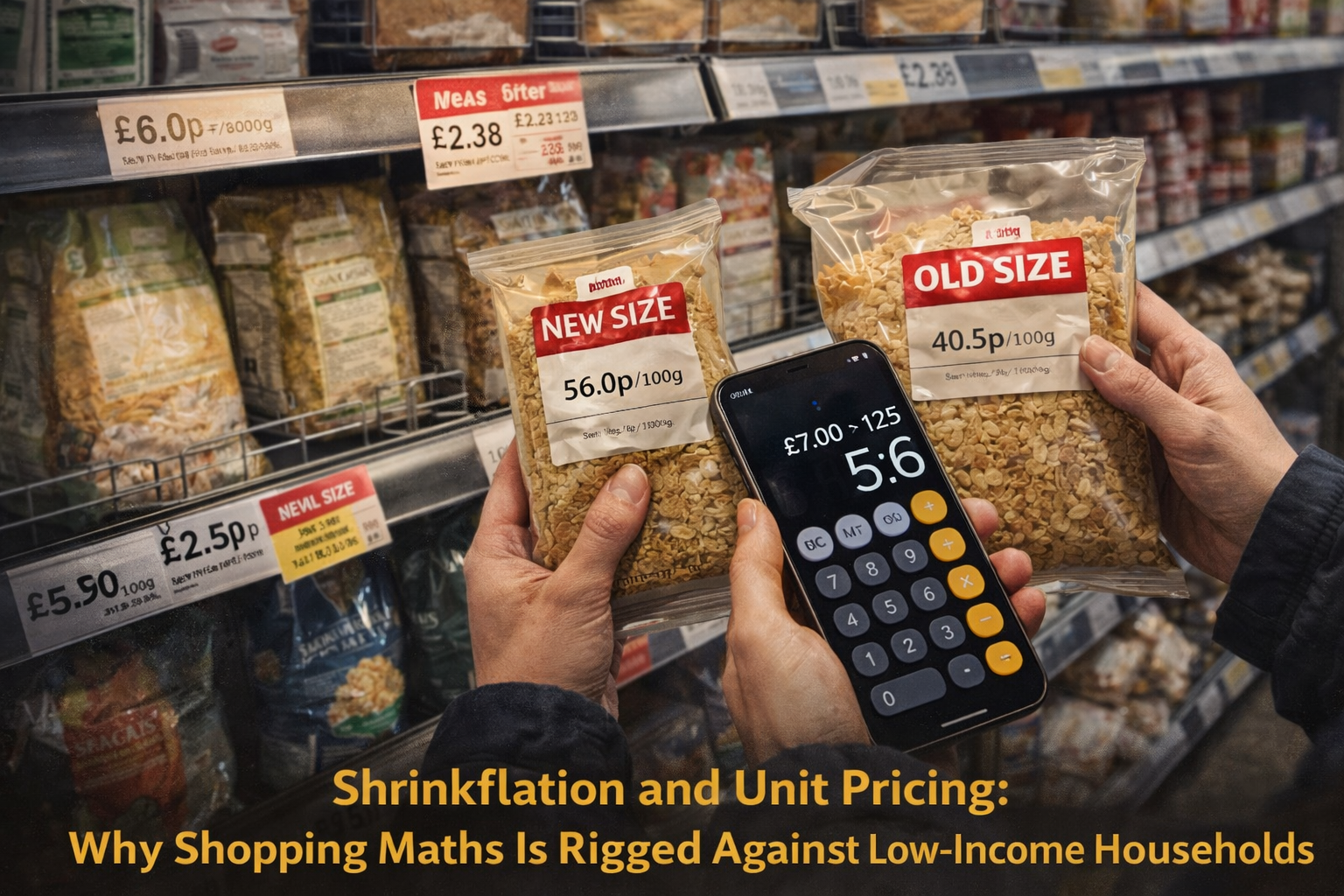
Shrinkflation is when the price stays similar but the pack gets smaller.
So your budget doesn’t “feel” like inflation.
It feels like your trolley is emptier for the same spend.
Public concern about shrinkflation has been rising in the UK.
It’s not paranoia.
It’s lived experience.
Why shrinkflation hits low-income households hardest
Shrinkflation punishes people who:
- can’t bulk buy
- can’t store extras
- can’t take risks on “bigger packs”
- shop little and often
It turns a tight budget into a tighter one, without warning.
Unit pricing should help, but it often doesn’t
Unit pricing is meant to make comparisons easy: price per 100g, per litre, etc.
But the Competition and Markets Authority (CMA) found problems with how unit pricing is displayed, affecting consumers’ ability to compare products.
And UK government research found that people on the very lowest incomes weren’t using unit pricing more, even under cost-of-living pressure.
So the tool exists, but the benefit doesn’t land equally.
This becomes a poverty penalty inside the same supermarket
Shrinkflation + inconsistent unit pricing creates a real-world effect:
People with more time, energy, and flexibility can “game” the shop.
People with less time and tighter budgets get clipped by:
- confusing comparisons
- small pack premiums
- missed value differences
- misleading “deals”
It becomes expensive to be exhausted.
Why this matters for food insecurity
Food insecurity isn’t only “no food”.
It’s also:
- lower nutrition
- fewer fresh ingredients
- more gaps between meals
- less predictable shopping
Pricing tricks add instability to households already managing risk daily.
What better protection could look like
Support here isn’t only food parcels.
It’s also:
- access to stable food models (pantries, social supermarkets)
- predictable weekly options
- support with budgeting and referrals
- reduced reliance on “shopping skill” to survive
When the system is noisy, households need stability.
What Feed & Flow can do here
Feed & Flow can treat pricing complexity as part of hunger reality:
- educate without blaming
- provide consistent, choice-based food access
- reduce the number of “gotcha” moments families face weekly
Because if people need a spreadsheet to shop safely, the system has already failed.