
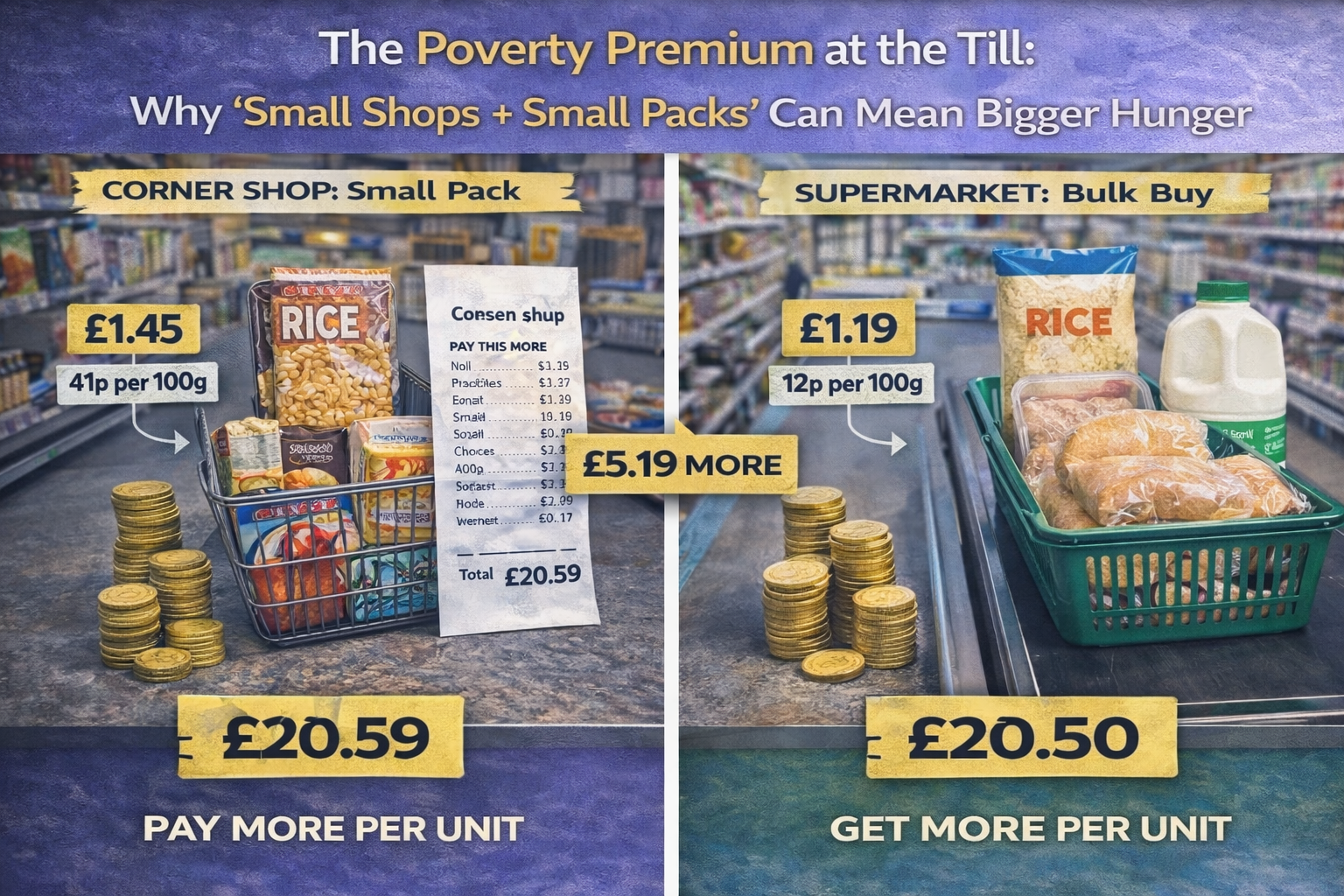
The Poverty Premium at the Till: Why “Small Shops + Small Packs” Can Mean Bigger Hunger
// NO DESCRIPTION DATA
Introduction
Food insecurity is often described like a simple shortage: not enough money, not enough food.
In reality, many households face a second problem at the same time: they pay more for the same essentials because they are poor.
That is the poverty premium. And it shows up loudest at the till.
The “small shop” reality most strategies ignore
A lot of advice assumes people can access a full supermarket, bulk-buy, store food safely, and plan a week ahead.
But many households shop differently because they have to:
- no car, limited transport
- unpredictable work hours
- limited storage or fridge space
- cash flow that works day-to-day, not month-to-month
- living near high streets full of convenience stores, not big supermarkets
When your food shop is mostly “top-ups” from local shops, you often pay more per unit than someone doing a weekly supermarket run. That is not a bad choice. It is a forced one.
Research on the poverty premium in London highlights how low-income households can pay more for essentials because cheaper options often require upfront cash, storage, transport, or access they do not have.
Shrinkflation turns budgeting into a trap
Shrinkflation is when the product looks the same, but the size quietly drops.
For households already buying smaller packs, shrinkflation hits twice:
- you get less per purchase
- you have to repurchase sooner
- the “quick top-up” cycle becomes constant
Which? has repeatedly highlighted shrinkflation across everyday groceries, where pack sizes reduce while prices stay similar or rise, making it harder for shoppers to compare value.
Unit pricing should help, but it often doesn’t
Unit pricing is supposed to make value obvious. In real life:
- labels vary by store
- sizes vary by brand
- “offer” signage distracts from the real cost
- people are shopping under pressure, not doing maths homework
When someone is trying to stretch £20 to cover dinners, lunches, breakfast, and snacks, the brain does not run like a spreadsheet. It runs like survival mode.
Food insecurity is also a “reliability” problem
The Food Foundation consistently frames food insecurity as a widespread UK issue, with households cutting portions, skipping meals, or compromising quality because budgets cannot carry the week.
That is why Feed & Flow treats food insecurity as more than calories. It is stability, dignity, and predictability.
What Feed & Flow does differently
Feed & Flow backs approaches that reduce the poverty premium instead of accidentally reinforcing it:
- cash-first help for flexibility and choice
- support for bulk-buying capability (storage, fridge repairs, delivery fees)
- grants for local projects to cover hidden costs that keep food affordable (transport, cold storage, packaging)
- partnerships that improve access, not just volume
Food support works best when it makes life easier, not when it expects perfect logistics from people living under constant constraint.