
No Table, No Pause, No Meal: Why Eating Space Still Shapes Food Insecurity
// NO DESCRIPTION DATA
Food support
Food support usually focuses on what people can buy, cook, or collect.
Less attention goes to something simpler: whether people have a decent place to sit and eat.
That may sound minor compared with income, debt, or energy bills. It is not. Eating space affects routine, appetite, family stress, and whether meals feel possible or chaotic. A household without a reliable place to gather, pause, and eat can drift into more fragmented and less nourishing habits very quickly.
Meals Work Better When Life Has a Shape
Regular eating depends on more than food being physically present.
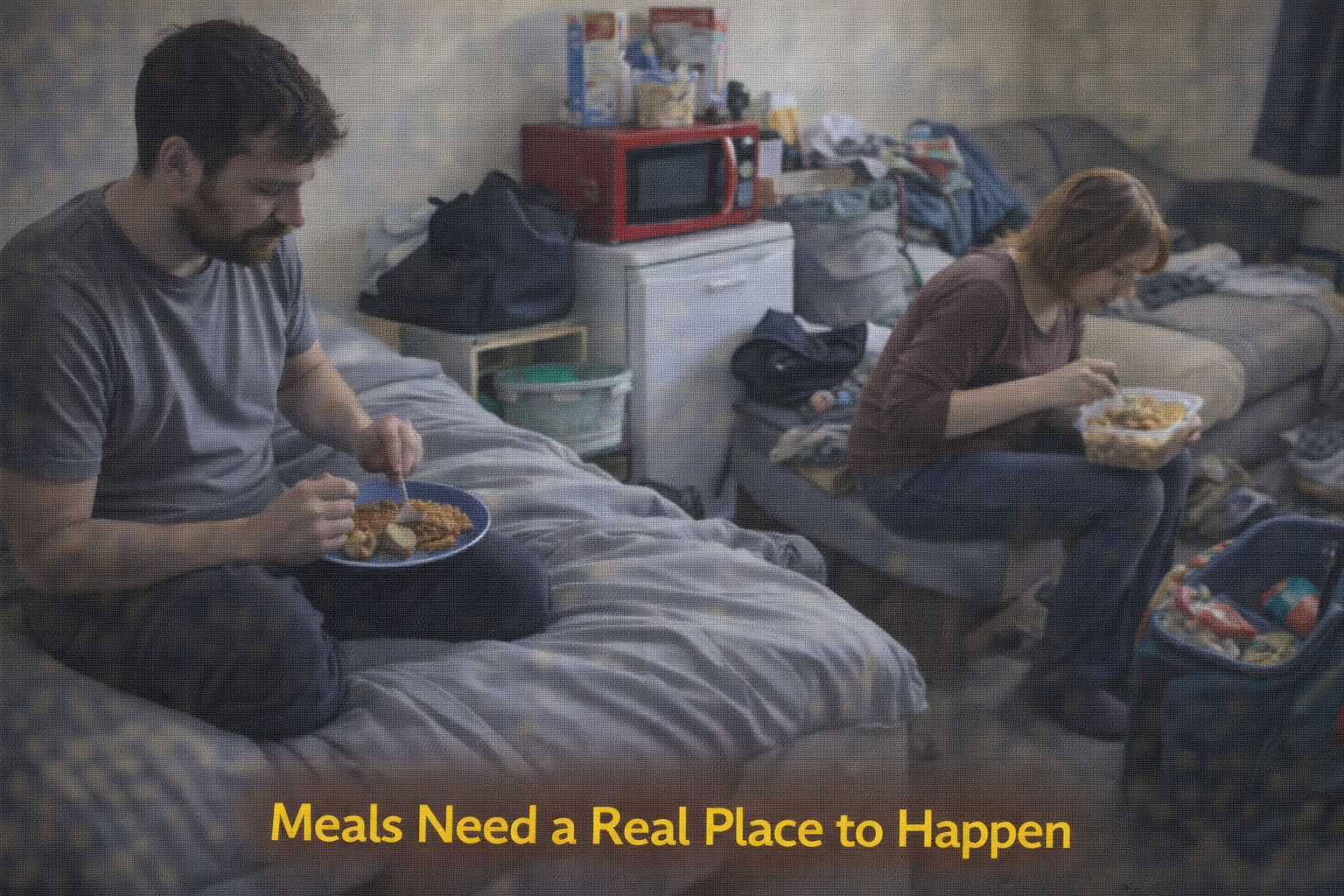
It depends on time, calm, and somewhere to put the plate down. In overcrowded homes, temporary spaces, shared rooms, or unstable housing, meals often happen in fragments. One person eats on a bed, another standing up, another later, another not at all. That does not just affect togetherness. It affects whether eating happens properly in the first place.
Routine is protective. When routine breaks down, so does consistency.
Chaotic Eating Is Not a Character Flaw
This matters because messy meal patterns are often judged unfairly.
A family may be described as disorganised when the real issue is that home does not support ordinary meal structure. No proper table. No clear communal space. Constant movement. Noise. Crowding. A sense that everything is temporary. In those conditions, cooking and eating become more exhausting than they look from the outside.
That can push households towards grab-and-go food, skipped meals, or everyone managing separately, which often means the adults lose out first.
Feed & Flow Should Remember That Hunger Is Environmental Too
Good food support is not blind to the setting around the food.
The goal is not only to get calories into a home. It is to understand what makes those calories usable, regular, and part of a stable life. Space matters. Routine matters. Dignity matters.
Feed & Flow should keep widening the frame like this. Hunger is not always an empty cupboard. Sometimes it is a home environment that makes normal eating harder than it should be.
Because when there is no table, no pause, and no real mealtime, food insecurity starts to live in the rhythm of the home itself.