
The Junk Food Default: Why “Cheap Calories” Win in Britain
// NO DESCRIPTION DATA
Unhealthy Diets
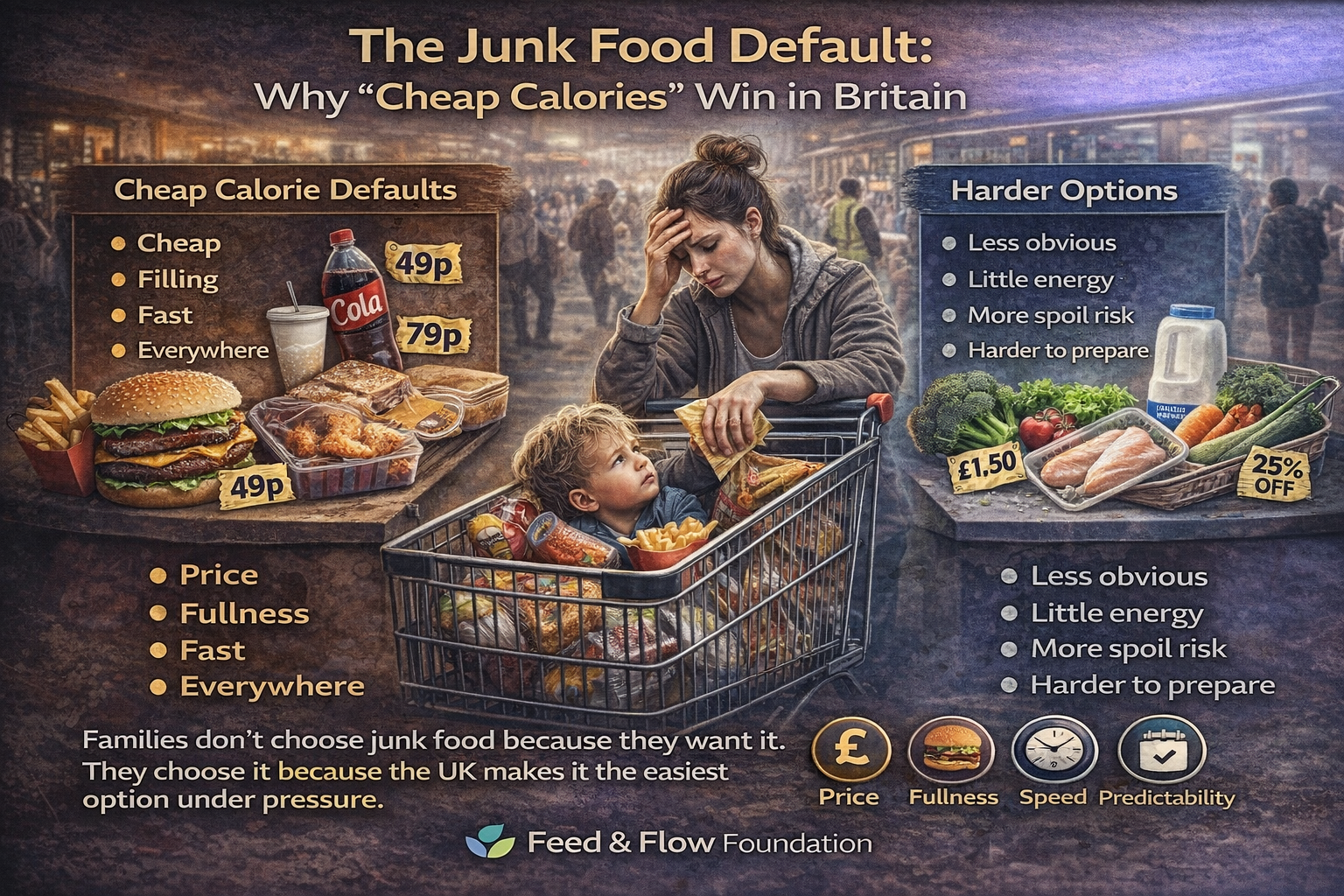
People talk about unhealthy diets like they’re caused by bad choices.
But in the UK, unhealthy diets are often caused by bad options.
When you’re under pressure, you don’t optimise for nutrition.
You optimise for:
- price
- fullness
- speed
- predictability
And the food system is built to win that game.
The problem isn’t knowledge. It’s the environment
Most families know what “healthy eating” looks like.
The issue is affordability, time, access, and exhaustion.
A lot of public space and retail design pushes:
- high sugar
- high caffeine
- high salt
- easy packaging
- high visibility
While healthier options are:
- less obvious
- less filling per pound
- more likely to spoil
- harder to prepare
That’s not a fair competition.
The child health impact is real, and it tracks poverty
In the UK, the junk food environment isn’t just annoying. It’s a health hazard.
Britain has a major child health problem linked to junk food access and affordability, with deprived areas hit hardest.
That’s why child hunger and child obesity can exist in the same household:
- not enough food and
- not enough good food
Why cheap calories become the household strategy
If you’re trying to stretch a budget, “value” becomes:
- calories that keep you full
- food that lasts
- food that kids will actually eat
- food that doesn’t risk waste
Ultra-processed options often win because they reduce risk:
- no prep required
- consistent taste
- long shelf life
- predictable cost
The system rewards survival decisions.
What meaningful food support looks like here
Food support that ignores nutrition turns into a loop:
- short-term calories
- long-term health decline
- higher costs and stress
- greater food insecurity
The solution is not shaming parents.
It’s backing projects that support:
- fresh food access that’s reliable
- culturally familiar food that gets eaten
- cooking access that’s realistic
- wraparound support that reduces the pressure
Feed & Flow is built for interventions that hold up under real life, not perfect life.