
Food Debt Is Rising: When Families Borrow to Eat and Pay It Back With Next Week’s Shopping
// NO DESCRIPTION DATA
The new warning sign of food insecurity: borrowing for groceries
Food insecurity used to show up as:
“we ran out”.
Now it often shows up as:
“we put it on something”.
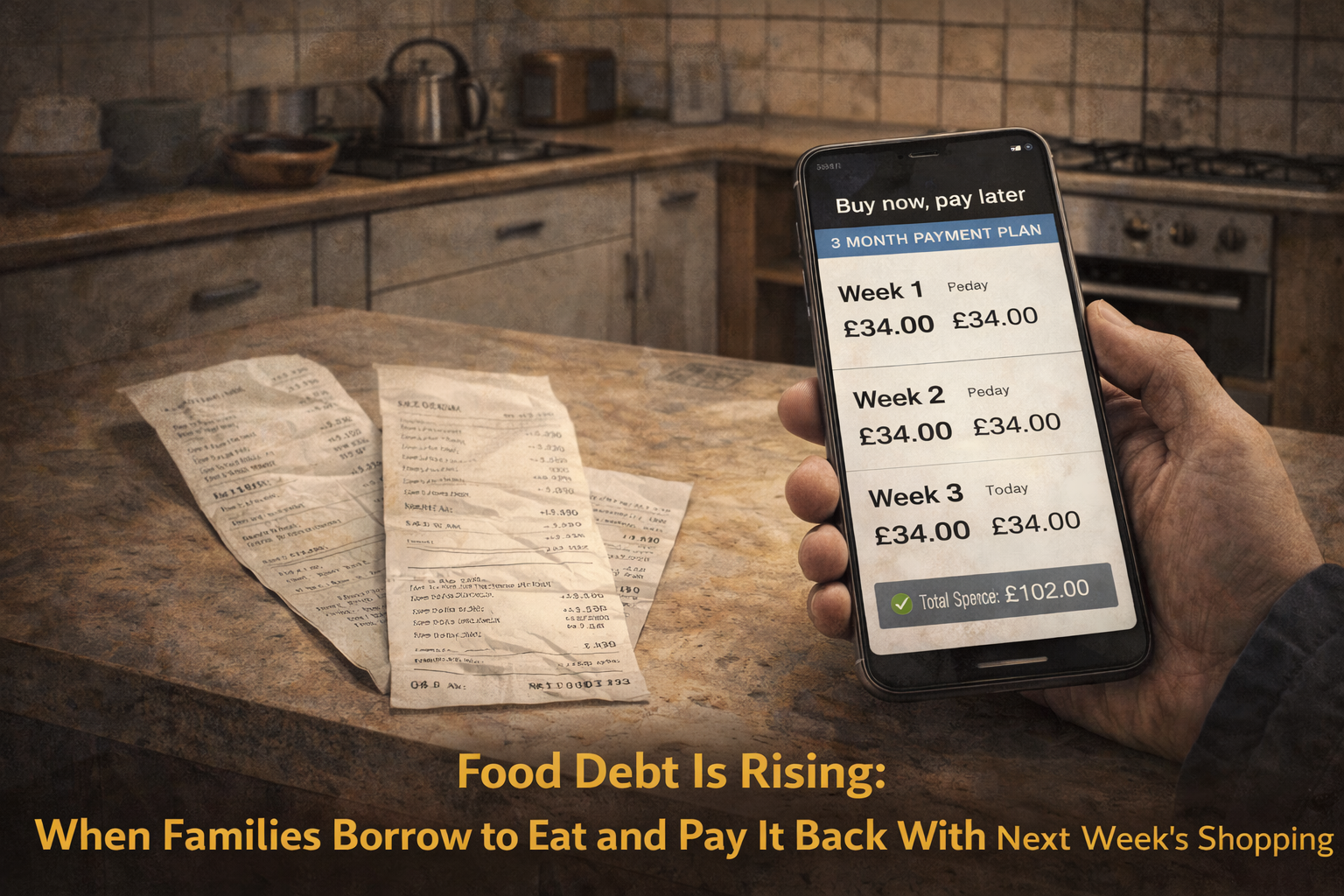
Citizens Advice found that 11% of BNPL users used it to pay for groceries, rising to 35% among regular BNPL users.
That’s not luxury spending.
That’s survival spending.
BNPL is growing, but groceries are still a key pressure point
UK Finance research notes that groceries make up a small share of BNPL overall (around 3%) and that BNPL hasn’t massively expanded into grocery payments in the UK.
But here’s the point:
you don’t need “mass adoption” for it to be a crisis signal.
If people are using credit for food at all, they’re already past the safe line.
The danger isn’t the product, it’s the cycle
Borrowing for food creates a loop:
week 1: credit buys the shop
week 2: repayment shrinks the next shop
week 3: another credit top-up
week 4: stress, arrears, deductions, panic
That’s how households get trapped:
not by one bad decision, but by repeated necessity.
“Affordable credit” helps some people, but it’s still a warning sign
There are schemes designed to reduce harm.
For example, Fair for You’s “Food Club” offers small interest-free credit for grocery shopping with structured repayments.
That can reduce immediate pressure.
But the need for it is still evidence of:
not enough income, not enough stability, too much volatility.
Why families borrow for food instead of asking for help
Because asking for help is heavy.
Borrowing feels:
- private
- faster
- less humiliating
- “temporary”
Until it isn’t.
What support works better than food debt
The best stabilisers are:
- cash-first support where safe and appropriate
- predictable food access with dignity
- advice links (benefits, debt, housing)
- consistent local networks
Basically: fewer emergencies, fewer spirals.
What Feed & Flow can do here
Feed & Flow can treat food debt as part of food insecurity:
- spot it early
- connect people to advice support before it escalates
- reduce reliance on credit through stable provision
- build pathways out, not just patches
Because when someone is borrowing to eat, they don’t need moral advice.
They need a system that stops the slide.